
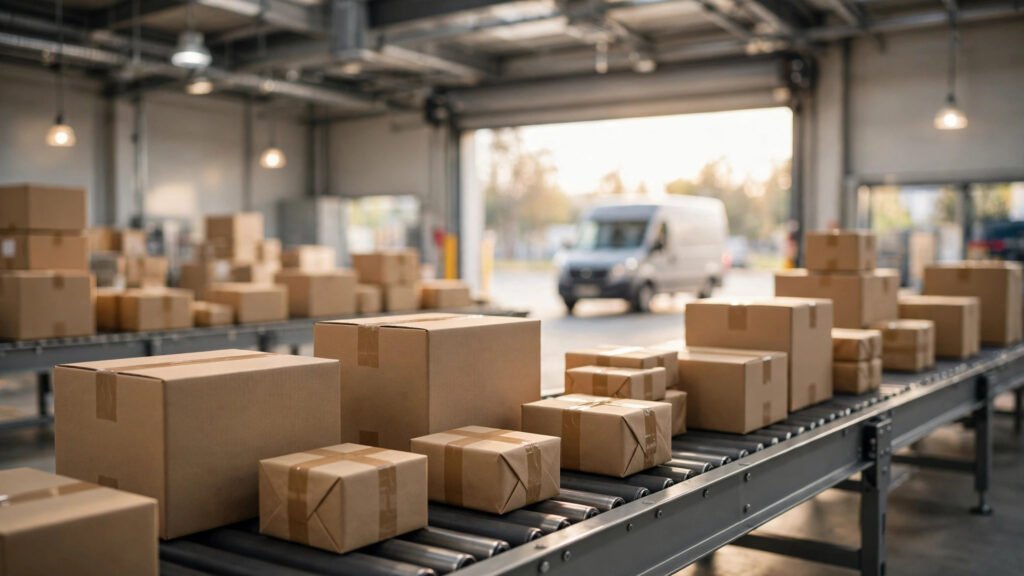
Your ecommerce shipping strategy is one of the most powerful profit levers in your online store — and one of the most overlooked. Shoppers now expect fast, affordable, and transparent delivery, and when shipping disappoints, they leave. Research from Baymard Institute has repeatedly found that unexpected extra costs, including shipping fees, are the single biggest reason shoppers abandon their carts. An effective ecommerce shipping strategy therefore does more than move boxes: it protects margins, lifts conversion rates, and turns one-time buyers into repeat customers.
In this guide, you will learn nine practical ways to build an ecommerce shipping strategy that cuts costs without cutting corners — covering carrier negotiation, packaging, free-shipping thresholds, delivery speed, returns, and automation. Whether you sell on Shopify, WooCommerce, or a marketplace, these tactics will help you ship smarter in 2026.
Table of Contents
- Key Takeaways
- Why Your Ecommerce Shipping Strategy Matters in 2026
- 1. Audit Costs: First Step in Your Ecommerce Shipping Strategy
- 2. Negotiate Carrier Rates — Even as a Small Store
- 3. Right-Size Your Packaging to Cut Dimensional Weight
- 4. Set a Smart Free-Shipping Threshold
- 5. Offer Tiered Delivery Options at Checkout
- 6. Use Regional Carriers and 3PL Warehouses
- 7. Automate Rate Shopping in Your Ecommerce Shipping Strategy
- 8. Make Returns Part of Your Ecommerce Shipping Strategy
- 9. Communicate Delivery Clearly to Reduce Support Tickets
- Frequently Asked Questions
📌 Key Takeaways
- Shipping is a conversion tool, not just a cost: unexpected shipping fees are a top cart-abandonment trigger, so transparency at checkout directly protects sales.
- Small savings compound: a few dollars saved per parcel, multiplied across hundreds of orders, can add thousands to annual profit.
- Free shipping works best with a threshold: set it just above your average order value to lift basket size while protecting margins.
- Automation pays for itself: rate shopping, label printing, and tracking updates save hours and prevent expensive manual errors.
- Returns are part of shipping: a clear, fair returns policy builds trust and brings customers back, even when a product goes back.
📦 Why Your Ecommerce Shipping Strategy Matters in 2026
Delivery expectations keep rising. Next-day and two-day delivery, once a premium perk, are now the benchmark set by the largest marketplaces. At the same time, carrier fuel surcharges, dimensional-weight pricing, and peak-season fees keep pushing costs up. Stores caught in the middle — promising fast, cheap delivery while absorbing rising costs — see margins shrink month by month.
A deliberate ecommerce shipping strategy breaks that squeeze. Instead of reacting to each carrier price rise, you design packaging, warehouse footprint, carrier mix, and checkout options around real data: what you ship, where customers live, and what speed they value. The result is cheaper to run, easier to explain, and far more resilient when rates change — and shipping becomes a reason customers choose you, not a reason they never return.

Caption: A well-run packing station is the foundation of any cost-saving ecommerce shipping strategy.
1. 🔍 Audit Costs: First Step in Your Ecommerce Shipping Strategy
Before you change anything, measure everything. Pull the last three months of carrier invoices and calculate your true cost per order: postage, packaging, labour, returns, and any reshipping. Most store owners are surprised — the headline postage rate is rarely the full story, and surcharges for residential delivery, oversized parcels, and address corrections quietly add up.
Segment by destination zone, weight band, and product type. You may find 20% of orders generate 60% of shipping spend — heavy items shipped cross-country, or a product whose box dwarfs the item inside. That segment is where your ecommerce shipping strategy should focus first. Set a baseline — cost per order, and shipping as a percentage of order value — and track it monthly.
2. 🤝 Negotiate Carrier Rates — Even as a Small Store
Carrier list rates are a starting point, not a final price. If you ship even 50 parcels a month, you can ask your account manager for a discount review. Carriers compete hard for small-business volume, and a polite, data-backed request — showing your monthly volume, average weight, and destination mix — often unlocks 10–20% savings.
Compare at least two national carriers plus one regional carrier before you negotiate. A competing quote is your strongest leverage, and it also protects you if one carrier raises rates or suffers delays. Revisit negotiations every six to twelve months, or whenever your volume jumps — growth is a bargaining chip, so use it.
Also check discounted-label platforms built into your store: Shopify Shipping, WooCommerce plugins, and third-party label services buy postage in bulk and pass part of the discount on, which can beat a direct carrier account for lower-volume stores. See Shopify’s shipping resources for authoritative rate guidance.
3. 📏 Right-Size Your Packaging to Cut Dimensional Weight
Carriers charge by dimensional weight — the space a parcel occupies — whenever it exceeds actual weight. Shipping a small item in a large box, stuffed with filler, means paying to transport mostly air. Right-sizing packaging is often the fastest, cheapest win in any ecommerce shipping strategy.
Stock three to four box sizes that fit your best-selling products snugly, plus mailers for soft or flat items. Measure your most-shipped products and choose packaging with minimal spare space. You will use less filler, pay lower dimensional-weight charges, and reduce damage claims — because items that cannot rattle around break less often.
4. 🎁 Set a Smart Free-Shipping Threshold
Free shipping converts — but unconditional free shipping can destroy margins. The smarter move is a threshold: free delivery on orders over a set amount, chosen deliberately to lift average order value. If your average order is $45, a $60 free-shipping threshold nudges many shoppers to add one more item, and that extra item often covers the shipping cost you absorb.
Test your threshold. Too high, and shoppers abandon carts when they miss it; too low, and you subsidise orders that were already profitable. Show a progress bar at checkout — “Add $12 more for free shipping” — because shoppers respond to visible, achievable goals. This single checkout element can lift both conversion and basket size, which is why it belongs at the heart of your ecommerce shipping strategy.
Pair the threshold with product strategy: bundle complementary items, suggest add-ons near it, and promote it on product pages, not just at checkout. If free shipping is impossible on heavy items, say so clearly. See our guide to ecommerce checkout optimization.
5. 🚀 Offer Tiered Delivery Options at Checkout
Not every customer wants the same delivery speed — or will pay for it. A tiered ecommerce shipping strategy (standard, express, and next-day where available) lets shoppers self-select: price-sensitive buyers choose standard, urgent buyers pay for speed, and that premium often subsidises standard rates.
Present delivery dates, not just speeds. “Arrives Friday, 30 October” is far more persuasive than “3–5 business days,” and it reduces “where is my order” queries. Show the options early — on the product page or cart — so shipping never becomes a checkout surprise. Our guide to ecommerce conversion rate optimization explains how checkout clarity lifts completed purchases.
Be careful with express promises you cannot keep. A missed express delivery damages trust far more than a slightly slower standard option. Only offer speeds your warehouse and carriers can reliably hit, including during peak periods.
6. 🗺️ Use Regional Carriers and 3PL Warehouses
National carriers are not always the cheapest or fastest option. Regional carriers often beat national rates within their home territory, especially for parcels under a few kilograms. Adding one regional carrier to your ecommerce shipping strategy can cut zone costs for a large share of your customers.
Location matters even more than carrier choice. If most of your customers live in one region, shipping everything from a single distant warehouse means paying long-zone rates on nearly every order. Splitting stock across two fulfilment locations — or using a third-party logistics (3PL) provider with multiple warehouses — puts products closer to buyers, cutting both transit time and zone pricing.
Start small: test a second location for top-selling products only. Shipping savings often outweigh extra storage cost, and faster delivery becomes a marketing advantage.

Caption: Regional carriers and well-placed stock shorten delivery routes and lower zone-based shipping costs.
7. 🤖 Automate Rate Shopping in Your Ecommerce Shipping Strategy
Manually comparing carrier rates for every order wastes hours and invites errors. Rate-shopping software compares live carrier prices at checkout or at label time and picks the cheapest service that meets your delivery promise. For stores shipping dozens of orders a day, the savings and time recovered are immediate.
Automation also covers labels, tracking emails, and address validation. Validating addresses at checkout prevents failed deliveries — you pay postage twice and still disappoint the customer — while automated tracking updates cut support tickets, because customers check a link instead of emailing you.
Modern AI tools can help here too: rate prediction, demand forecasting, and picking optimisation are increasingly accessible to small stores. These step-by-step AI tutorials explain popular AI tools in plain language. Automate repetitive work so your team can focus on exceptions — the damaged parcel, the lost shipment, the customer who needs a human.
8. ↩️ Make Returns Part of Your Ecommerce Shipping Strategy
Returns are not a separate problem from shipping — they are half of it. A confusing or punitive returns policy suppresses first purchases, because shoppers mentally add return risk to the price. A clear, fair policy does the opposite: it makes buying feel safe.
Offer a prepaid return label or a simple QR-code drop-off where feasible, and state the return window and condition requirements in plain words on the product page. You do not have to offer free returns on everything — many successful stores charge a modest return fee or offer free returns only above a threshold — but the policy must be easy to find and easy to understand.
Track return reasons: repeated sizing returns mean fixing the size guide; recurring damage means fixing packaging. Every return prevented saves shipping twice — outbound and inbound. See also our guide to reducing cart abandonment.
9. 💬 Communicate Delivery Clearly to Reduce Support Tickets
The final tactic costs almost nothing: tell customers what is happening, before they ask. Send an order confirmation, a dispatch notification with tracking, and a delivery confirmation. Add a branded tracking page so customers return to your store — not a carrier site — to check progress.
On product pages, state realistic delivery ranges and cut-off times for same-day dispatch, and update banners early if peak-season lead times lengthen; customers forgive honest delays far more readily than silent ones. Clear communication is part of a strong ecommerce shipping strategy. Track “where is my order” tickets as a share of orders — when that number falls, your communication is working.
Putting It All Together: Your 30-Day Ecommerce Shipping Strategy Plan
Week one: audit costs and packaging. Week two: request carrier quotes and test a free-shipping threshold. Week three: add one regional carrier or rate-shopping tool and automate tracking emails. Week four: publish your returns policy clearly and measure cost per order again. You need not implement all nine tactics at once — the audit alone usually reveals quick wins worth thousands a year.
Shipping strategy is never finished: rates change, product mixes evolve, and customer locations shift. Review numbers quarterly, renegotiate annually, and treat delivery as a product feature you keep improving.

Caption: Customers judge a store by its delivery experience — make yours fast, clear, and fairly priced.
❓ Frequently Asked Questions
What is an ecommerce shipping strategy?
An ecommerce shipping strategy is your plan for how products reach customers profitably: carriers, charges, packaging, stock locations, and returns. A good strategy balances cost, speed, and experience instead of treating shipping as an afterthought.
How can small stores afford free shipping?
Most small stores cannot afford unconditional free shipping — and should not offer it. Use a free-shipping threshold above your average order value, build part of the cost into product pricing, or offer free shipping on selected products. The goal is a threshold that lifts basket size enough to cover the cost.
Which carrier is cheapest for ecommerce?
There is no single cheapest carrier — it depends on parcel weight, size, destination zone, and volume. Compare at least two national carriers and one regional carrier for your actual shipment profile, and re-check rates when your volume or product mix changes.
How do I reduce dimensional-weight charges?
Use packaging that fits each product closely, stock multiple box sizes, and switch bulky items to mailers where protection allows. Weigh and measure your most-shipped products, then choose the smallest safe packaging for each.
Should I use a 3PL for shipping?
A 3PL makes sense when order volume, warehouse labour, or multi-location shipping overwhelms your team. Compare 3PL fees against your current cost per order — including your time — and trial it with best-sellers first before moving your full catalogue.
How often should I review my shipping strategy?
Review costs monthly, renegotiate carrier rates every six to twelve months, and do a full strategy review quarterly or whenever you add products, enter new markets, or see a sharp change in order volume.
Sources note: Cart-abandonment research from Baymard Institute’s published checkout studies; carrier pricing concepts from public rate guides of major carriers and Shopify’s shipping guidance. Figures are industry benchmarks — test thresholds and carriers against your own order data.