
Table of Contents
- What Is AI in Manufacturing?
- 1. Predictive Maintenance That Prevents Costly Downtime
- 2. AI Quality Inspection That Catches Defects Instantly
- 3. Smarter Supply Chains and Demand Forecasting
- 4. Robotics and Cobots on the Factory Floor
- 5. Digital Twins and Smarter Production Planning
- 6. Energy Efficiency and Sustainable Manufacturing
- 7. A Safer, More Skilled Manufacturing Workforce
- 8. Your 5-Step Roadmap to AI in Manufacturing
- 9. Costs, ROI, and Challenges to Plan For
- Frequently Asked Questions
Key Takeaways: AI in manufacturing is no longer a pilot-project luxury — it is a practical toolkit that cuts downtime, improves quality, and lifts output. Start with one high-impact use case such as predictive maintenance, measure the return, then scale. The factories winning in 2026 pair smart technology with skilled people, clean data, and a clear roadmap.
AI in manufacturing is reshaping how factories run in 2026. From predictive maintenance that stops machines before they break to computer vision that inspects every product in real time, artificial intelligence is moving from the boardroom slide deck to the factory floor. For manufacturers of every size, the question is no longer whether to adopt AI in manufacturing, but where to start and how fast to scale.
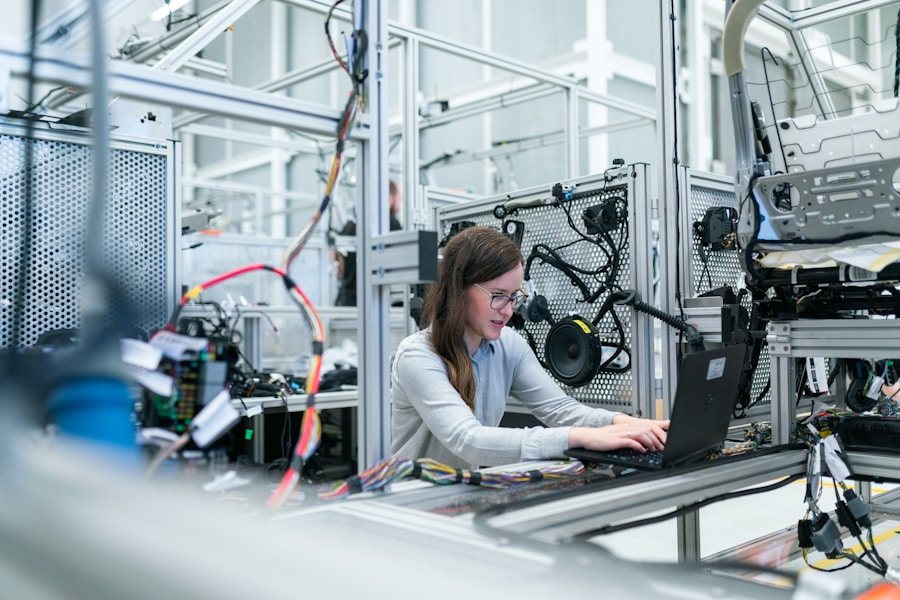
Engineers use AI in manufacturing dashboards to monitor production lines, machine health, and output in real time.
📋 What Is AI in Manufacturing?
AI in manufacturing means using machine learning, computer vision, robotics, and data analytics to improve how products are designed, produced, inspected, and delivered. A useful way to think about it is that traditional automation follows fixed rules, while AI in manufacturing learns from data and improves over time. A vision system, for example, does not just compare a part against one fixed template; it learns what a good part looks like across thousands of examples, including variations in lighting, material, and finish.
Most factory AI applications fall into four groups: predictive (forecasting failures, demand, or quality problems), perceptive (cameras and sensors that see and measure), prescriptive (recommendations for the best schedule or setting), and autonomous (robots and systems that act on those recommendations with human supervision). The most successful programmes combine all four.
🤖 1. Predictive Maintenance That Prevents Costly Downtime
Predictive maintenance is the single most popular entry point for AI in manufacturing, and for good reason. Sensors on motors, pumps, bearings, and CNC machines stream vibration, temperature, pressure, and current data. Machine learning models learn each asset’s normal behaviour and flag subtle changes weeks before a failure. Instead of servicing machines on a fixed calendar — too early and you waste parts, too late and you suffer a breakdown — teams service exactly when the data says they should.
Industry analyses commonly report that AI-driven predictive maintenance can cut unplanned machine downtime by up to 50% and reduce maintenance costs by 10–40%. The business case is easy to test: pick your most failure-prone asset, instrument it, and compare downtime before and after. Even one avoided line stoppage can pay for the pilot. For a deeper look at the tools behind this shift, see the practical overviews in step-by-step AI tutorials that walk through AI tools for real business workflows.
2. AI Quality Inspection That Catches Defects Instantly
Human inspection is skilled work, but it is slow, tiring, and inconsistent over long shifts. AI in manufacturing changes the equation with computer vision: high-speed cameras photograph every part, and trained models classify defects — scratches, cracks, misalignments, missing components — in milliseconds. Unlike sampling, which checks a fraction of output, vision systems can inspect 100% of production without slowing the line.
The payoff shows up in three places: fewer defective products reaching customers, less scrap and rework, and a complete digital record of every inspection for traceability. Food, pharmaceutical, electronics, and automotive suppliers are adopting this fastest, because the cost of a recall or a rejected batch dwarfs the cost of the cameras. The key lesson is to train models on your own defect library — your products, materials, and lighting are unique.

AI in manufacturing vision systems inspect every product on the line, catching defects humans might miss on long shifts.
3. Smarter Supply Chains and Demand Forecasting with AI in Manufacturing
Few manufacturers were untouched by recent supply shocks, and AI in manufacturing is now a core supply-chain tool. Machine learning forecasts demand far more accurately than a spreadsheet average because it weighs dozens of signals at once: seasonality, promotions, weather, commodity prices, supplier lead times, and even news events. Better forecasts mean less safety stock, fewer stockouts, and less working capital tied up in warehouses.
Beyond forecasting, AI helps teams react when plans break. If a supplier delays a shipment, an AI planning tool can instantly suggest alternatives — a different supplier, a substitute material, or a rescheduled run — ranked by cost and delivery impact. The practical rule is simple: AI does not remove uncertainty, but it shrinks the time between a disruption and a good decision from days to minutes.
4. Robotics and Cobots on the Factory Floor
Industrial robots have welded, painted, and palletised for decades. What is new in 2026 is flexibility. AI-powered robots use vision and force sensing to handle varied parts, adapt to small changes, and work safely alongside people. Collaborative robots, or cobots, are the fastest-growing segment because they are smaller, easier to program, and affordable for mid-sized plants — a team can teach a cobot a pick-and-place task in hours, not weeks.
The smartest deployments do not replace people; they remove the dull, dirty, and dangerous tasks from people’s days. Robots take the repetitive lifting and high-precision repetition, while operators supervise, handle exceptions, and focus on quality. Plants that frame robotics as augmentation rather than replacement consistently report better adoption, because the workforce becomes the champion of the change.
5. Digital Twins and Smarter Production Planning
A digital twin is a live virtual replica of a machine, a line, or an entire factory, fed by real sensor data. Engineers test changes in the twin before touching the real plant: What happens if we speed up line two by 8%? Which schedule clears the backlog fastest? Where will the next bottleneck form? AI in manufacturing makes twins genuinely useful, because the model learns from real behaviour rather than relying only on engineering assumptions.
For production planning, AI scheduling tools weigh orders, machine availability, labour, materials, and energy prices simultaneously, then propose schedules humans can adjust. The result is higher utilisation, shorter lead times, and fewer missed promises. If a full-plant twin feels ambitious, start with a twin of one bottleneck cell — the learning and the savings transfer quickly.
🏭 6. Energy Efficiency and Sustainable Manufacturing
Energy is one of the largest controllable costs in manufacturing, and AI in manufacturing is proving to be a powerful efficiency lever. Machine learning models optimise heating, cooling, compressed air, and oven cycles in real time, trimming waste without affecting output quality. Some plants use AI to shift energy-intensive work to off-peak hours automatically, cutting both bills and carbon emissions.
Sustainability gains compound. Less scrap means less raw material and less energy per good unit. Predictive maintenance extends equipment life, delaying replacement. And the same data that powers AI also powers credible sustainability reporting, which customers and regulators increasingly demand.

Data analysis is the backbone of AI in manufacturing, turning sensor streams into decisions on energy, quality, and scheduling.
7. A Safer, More Skilled Manufacturing Workforce
AI in manufacturing also changes the human side of the factory — for the better, when it is deployed thoughtfully. Vision systems can spot unsafe behaviour near machinery and alert supervisors before an incident. Wearables and fatigue-monitoring tools help protect workers on long shifts. And AI tutors and augmented-reality guidance help new operators learn complex tasks faster, with step-by-step instructions overlaid on the equipment in front of them.
The skills story matters. As routine tasks automate, demand grows for roles that blend shop-floor knowledge with data skills: maintenance technicians who read model alerts, quality engineers who curate defect data, and planners who work with AI schedules. Forward-looking manufacturers invest in upskilling alongside technology and involve operators in pilot design from day one — operators know where the real problems are, and their buy-in decides whether a pilot survives.
8. Your 5-Step Roadmap to AI in Manufacturing
Successful AI in manufacturing programmes share a pattern. Follow these five steps in order, and resist the temptation to buy technology before you have defined the problem:
- Pick one painful, measurable problem. Downtime on one line, scrap on one product, or forecast error on one category. If you cannot measure it, you cannot prove the return.
- Audit your data. Check what sensors, logs, and records already exist, how clean they are, and who owns them. Most pilots stall on data, not algorithms.
- Run a 90-day pilot. Scope it tightly, assign one owner, and define success in advance — for example, a 20% cut in unplanned stops.
- Measure honestly, then decide. Scale what beats the baseline, fix or kill what does not, and publish the result internally so the next team starts smarter.
- Scale in waves. Roll the proven use case to similar lines, then add the next use case. Governance, security, and training scale with the technology.
External research is worth consulting as you plan. If you are already exploring automation more broadly, our guide to AI automation tools is a good companion read, and the same data-driven thinking is transforming other sectors too, from AI in retail to AI in healthcare. McKinsey’s operations insights and Deloitte Insights regularly publish manufacturing and AI adoption research that helps benchmark your roadmap against industry peers.
9. Costs, ROI, and Challenges to Plan For
Costs vary widely, but a realistic pilot budget for AI in manufacturing includes sensors and connectivity, a software platform or cloud service, integration work, and — most importantly — people’s time for data preparation and change management. Cloud-based AI tools and off-the-shelf vision systems have brought pilot costs down sharply, which is why mid-sized manufacturers are now adopting at a pace once reserved for large enterprises.
Return on investment typically arrives through four channels: less downtime, less scrap and rework, lower inventory and energy costs, and higher throughput from the same assets. A disciplined pilot should show a payback case within two to four quarters. The challenges to plan for are real: messy or siloed data, cybersecurity exposure from newly connected machines, integration with legacy equipment, and retraining teams. None of these is a reason to wait — they are reasons to start small, secure the pilot properly, and build expertise as you scale.
Frequently Asked Questions
Is AI in manufacturing only for large factories?
No. Cloud tools, affordable sensors, and easy-to-program cobots have lowered the entry cost sharply. Mid-sized and even small manufacturers now run successful pilots focused on one line or one problem, then scale from proven results.
How long does an AI in manufacturing pilot take?
A focused pilot typically runs 60–90 days: a few weeks for data preparation and setup, several weeks of live running, and a final review against the success metric you set at the start.
Will AI in manufacturing replace factory workers?
The evidence points to augmentation, not wholesale replacement. AI takes over repetitive, hazardous, and inspection-heavy tasks, while demand grows for technicians, quality engineers, and planners who work alongside AI systems.
What data do I need to start with AI in manufacturing?
Start with what you already have: machine logs, maintenance records, quality data, and production schedules. Clean, labelled data for one use case beats a massive, messy data lake every time.
How do I choose the right AI in manufacturing vendor?
Ask for references from plants like yours, a clear pilot scope with success metrics, and proof the solution integrates with your machines. Prefer vendors who train your team rather than locking knowledge away.
Is AI in manufacturing secure?
Connected machines do expand the attack surface, so security must be part of the pilot: segmented networks, patched systems, and access controls. Done properly, a modern AI deployment is more secure than an unmonitored legacy setup.
Conclusion
AI in manufacturing is not a futuristic promise — it is a set of proven tools delivering measurable results in factories today. Predictive maintenance prevents downtime, vision systems protect quality, smarter forecasting steadies supply chains, and robotics frees people for higher-value work. The manufacturers pulling ahead in 2026 are not the ones with the biggest AI budgets; they are the ones that picked one painful problem, ran a disciplined pilot, and scaled what worked. Start there, and let the results fund the next wave.
Sources note: This guide draws on widely published industry research on manufacturing AI adoption, including operations insights from McKinsey and Deloitte, and on Digital 365 Agency’s own coverage of AI tools and automation. Figures cited are typical industry ranges reported across such research, not guarantees for any single plant.