
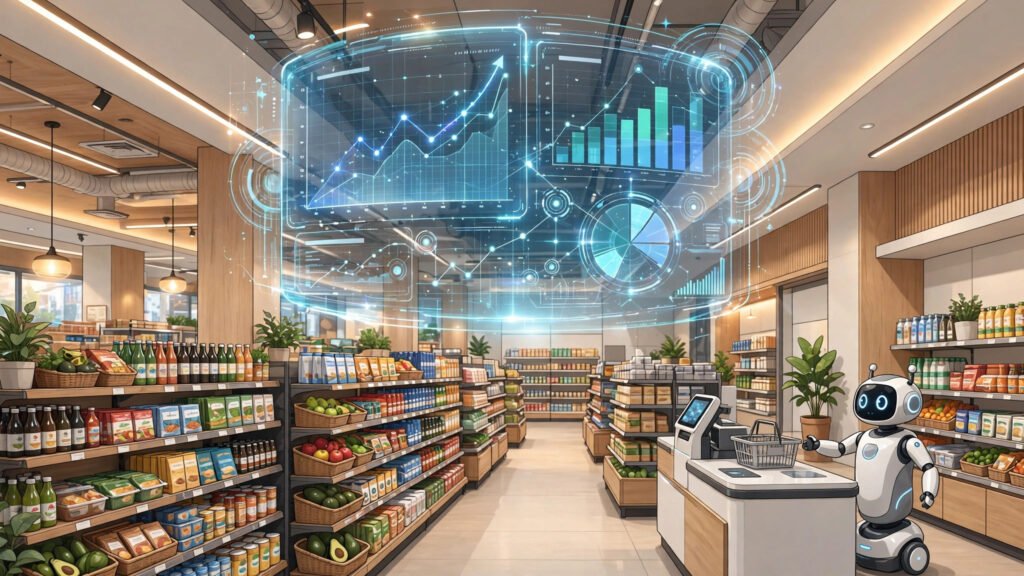
Walk into a well-run store in 2026 and you might not notice the AI in retail working all around you — but it is there. It predicted which products would sell out this weekend, set the price on the shelf tag, recommended the jacket now sitting in a shopper’s online cart, and quietly flagged the empty shelf that a restocking alert just fixed. Retail has quietly become one of the most AI-saturated industries on earth.
The numbers back it up. In their 2026 report Rewiring retail in Europe: The AI imperative, McKinsey & Company and EuroCommerce estimate the AI in retail opportunity at €240–320 billion across the value chain — and report that roughly 89% of retail and CPG companies are now actively using or testing AI. On the consumer side, McKinsey’s 2026 survey found that 63% of shoppers use AI-powered tools to compare products before buying. The question for store owners is no longer whether AI belongs in retail, but how fast they can put it to work.
Whether you run a single boutique or a chain, these nine applications of artificial intelligence in retail are delivering measurable results in 2026 — the platforms behind each one and where to start.
📌 Key Takeaways
- €240–320 billion at stake. McKinsey & EuroCommerce (2026) put the AI in retail opportunity across merchandising, marketing and supply chains.
- 89% of retail and CPG companies now use or test AI — but most still struggle to scale pilots into profit.
- Personalization pays. AI-driven recommendations lift revenue 10–15% on average and drive up to 31% of e-commerce revenue.
- 63% of shoppers compare products with AI tools before buying — your catalog needs to be AI-readable, not just human-readable.
- Start with one high-ROI use case (forecasting or recommendations), prove the return, then expand.
Table of Contents
- AI in Retail for Demand Forecasting & Inventory
- Personalized Product Recommendations
- AI-Powered Dynamic Pricing
- Visual Search & AI Shopping Assistants
- Checkout-Free Stores & Smart Self-Checkout
- AI in Retail Loss Prevention & Shelf Monitoring
- AI Marketing & Ad Personalization
- AI Chatbots for Retail Customer Service
- Workforce Scheduling & Store Operations
- How to Start Using AI in Retail
- FAQs
1. 📦 AI in Retail for Demand Forecasting & Inventory Management
Stockouts and overstock are the twin profit-killers of retail — and the number-one place AI in retail is earning its keep. Machine-learning models now ingest years of sales history, seasonality, promotions, weather data and even local events to predict demand SKU by SKU, store by store, often with far better accuracy than spreadsheet-based planning.
The payoff is concrete: fewer empty shelves, less capital tied up in slow-moving stock, and less waste — a big deal for grocery and fashion, where markdowns and spoilage quietly eat margins. Enterprise platforms like Blue Yonder and RELEX Solutions (custom enterprise pricing) serve large chains, while smaller retailers can get AI-driven forecasting inside tools like Shopify’s inventory apps and Cin7 (paid plans vary by catalog size).
Practical play: start with your top 20% of SKUs by revenue. Nail the forecast for the products that matter most, measure the reduction in stockouts and markdowns, then roll AI forecasting across the catalog.
2. 🎯 Personalized Product Recommendations That Lift Sales
“Customers who bought this also bought…” has grown up. Modern retail AI recommendation engines build a live profile of every shopper — browsing behavior, purchase history, even the time of day they shop — and serve product suggestions across the homepage, product pages, email and ads.
This is one of the highest-ROI applications in all of AI in retail: McKinsey research attributes a 10–15% average revenue lift to AI-driven personalization, and industry data suggests personalized recommendations can drive up to 31% of total e-commerce revenue. Platforms like Nosto, Dynamic Yield (now part of Mastercard) and Algolia Recommend (usage-based pricing) plug into most e-commerce stacks in days, not months.
Practical play: don’t limit recommendations to the product page. Cart-page and post-purchase email recommendations consistently show the highest click-through — that’s where personalization money is made.
3. 💲 AI-Powered Dynamic Pricing
Airlines have priced dynamically for decades; in 2026, AI in retail is bringing the same discipline to store shelves. Pricing engines monitor competitor prices, demand signals, inventory levels and margin targets in real time, then adjust prices automatically within guardrails you set.
Done well, dynamic pricing protects margins on hot items while clearing slow stock before it becomes dead stock. Grocery chains use it to mark down perishables intelligently through the day; electronics retailers use it to stay competitive without racing to the bottom. Tools like Pricemoov and Wiser (pricing varies by catalog size) specialize in retail price optimization, and several POS systems now include basic repricing rules out of the box.
One caution: shoppers notice erratic pricing. Keep a pricing fairness policy — cap daily changes, never personalize prices on protected attributes, and always be able to explain a price. Trust is a margin too.
Modern stores use AI in retail to manage inventory, pricing and shelf availability in real time.
4. 📸 Visual Search & AI Shopping Assistants
Shoppers increasingly start with a picture, not a keyword. Visual search lets a customer snap a photo of a lamp, a pair of sneakers or a living-room setup and instantly find the same — or similar — products in your catalog. AI in retail makes this possible through image-recognition models trained on your product feed.
Free consumer tools like Google Lens and Pinterest Lens already drive discovery traffic to retailers with well-structured image data, while dedicated platforms such as Syte (custom pricing) add visual search and AI-powered product tagging directly to your store — including conversational assistants that suggest outfits and alternatives from a single photo.
Practical play: visual search is only as good as your product data. Clean titles, complete attributes and high-quality images on every SKU — this is also what makes your catalog legible to the AI assistants shoppers now use to compare products.
5. 🛒 Checkout-Free Stores & Smart Self-Checkout
The most visible face of AI in retail is the store with no lines. Computer-vision systems track what shoppers pick up, then charge them automatically as they walk out — pioneered by Amazon’s Just Walk Out technology and now offered by vendors like Zippin to independent grocers.
Full checkout-free retrofits are still a capital project, but a cheaper on-ramp exists: AI-assisted self-checkout that uses cameras to recognize produce and flag unscanned items, cutting both shrink and the awkward “unexpected item in the bagging area” moments.
Watch the economics: checkout-free works best in high-traffic, small-basket formats (convenience, grab-and-go food, stadiums). Run the labor-savings math against the hardware and camera-infrastructure cost before committing.
6. 👁️ AI in Retail Loss Prevention & Shelf Monitoring
The same computer vision that enables checkout-free shopping is transforming retail back-of-house work. Ceiling cameras paired with AI in retail vision models now detect empty shelves, misplaced products and pricing-label mismatches in real time — turning the old clipboard shelf-audit into a continuous, automated process.
On the loss-prevention side, AI flags suspicious behavior patterns at self-checkout and loading docks far more consistently than tired human monitoring. Platforms like Trax and Pensa Systems (enterprise pricing) specialize in shelf-intelligence, while several modern CCTV providers now bundle AI analytics that distinguish genuine incidents from false alarms.
The hidden win here is on-shelf availability: a meaningful share of lost sales comes from products that are in the building but not on the shelf — and AI shelf monitoring closes that gap automatically.
From smart checkout to AI support, retail technology is reshaping every customer touchpoint.
7. 📣 AI Marketing & Ad Personalization for Retailers
Retail media is booming, and AI in retail marketing decides which ad each shopper sees. Generative AI now drafts product descriptions, ad variants and email subject lines at a scale no human team can match — then machine learning allocates spend toward the combinations that convert.
The practical stack in 2026: AI-generated creative variants for Meta and Google ads, predictive audiences built from first-party purchase data, and send-time optimization for email and SMS. AI-written product descriptions, properly edited, ship 5–10x faster than manual copywriting — but keep a human review step, since generative copy can still invent product features if you let it.
For the broader playbook on automating the marketing around your store, see our guide to AI automation tools for business — many of the same platforms handle retail marketing workflows.
8. 💬 AI in Retail Customer Service: Chatbots That Sell
“Where is my order?”, “Do you have this in size medium?”, “What’s your return policy?” — retail support is dominated by repetitive questions, which makes it the perfect job for AI in retail chatbots. Modern retail bots handle order tracking, returns initiation, product Q&A and even guided selling around the clock, escalating to humans only when the conversation needs judgment.
The economics are compelling: industry data suggests AI customer-service automation can return around $3.50 for every $1 invested, and AI phone support for smaller stores now starts at accessible monthly pricing. For a deeper comparison of the leading platforms, read our roundup of the best AI chatbots for business — most of the top picks include retail-specific templates for order status and returns.
Practical play: train the bot on your actual returns policy, shipping times and top 50 product FAQs. A chatbot that answers from your real policies beats a generic one every time — and it keeps working at 2 a.m. on Black Friday.
9. 🗓️ Workforce Scheduling & Store Operations
Labor is a retailer’s biggest controllable cost, and AI in retail scheduling tools are getting scary-good at optimizing it. These systems forecast foot traffic by hour, then build staff schedules that match demand — cutting both overstaffing during dead hours and the long lines that cost sales during rushes.
Platforms like Legion and Deputy (paid plans vary by location count) combine demand forecasting with employee preferences and labor-law compliance — cutting scheduling time and staff turnover, since employees prefer predictable, preference-aware shifts.
Pair scheduling AI with demand forecasting and you get a store that staffs and stocks itself around predicted demand.
🚀 How to Start Using AI in Retail
The retailers seeing returns in 2026 follow a simple sequence:
- Pick one high-ROI use case. Demand forecasting (#1) or product recommendations (#2) usually pay back fastest because they touch revenue directly.
- Audit your data. AI is only as good as the sales history, product feed and customer data behind it. Clean data first, models second.
- Run a 90-day pilot in one store or category. Measure stockouts, conversion rate or labor hours — one metric, honestly tracked.
- Train your team. McKinsey’s 2026 research found the biggest barrier to scaling retail AI is organizational, not technical — change management and training matter more than the algorithm.
- Expand what works. Roll the winning use case across locations, then add the next one.
If you’re new to the AI landscape, the step-by-step AI tutorials at AIToolSteps are a practical starting point for understanding the tools before you buy. And if your pricing strategy needs a rethink alongside the tech, see how AI is transforming finance and banking — many of the same forecasting techniques apply to retail revenue planning.
AI in retail analytics turns shopping data into personalized experiences and smarter decisions.
❓ FAQs
How is AI used in retail stores today?
AI in retail covers demand forecasting, personalized recommendations, dynamic pricing, visual search, checkout-free stores, shelf monitoring with computer vision, AI marketing, customer-service chatbots and workforce scheduling. McKinsey & EuroCommerce estimate the total opportunity at €240–320 billion, with about 89% of retail and CPG companies now using or testing AI.
Can small retail businesses afford AI tools?
Yes — this is one of the biggest shifts of 2026. Many AI features are now bundled into affordable tools: Shopify apps add forecasting and recommendations, AI phone support starts at accessible monthly rates, and free tools like Google Lens drive visual-search discovery. Start with one use case and scale from proven ROI.
Does AI in retail replace store employees?
It reshapes roles more than it removes them. AI handles forecasting, scheduling and repetitive questions while staff shift to customer experience and merchandising. McKinsey’s 2026 research found the main barrier to scaling is organizational — training and change management — not the technology itself.
What is the ROI of AI in retail?
Results vary by use case, but the benchmarks are strong: AI personalization lifts revenue 10–15% on average, recommendations can drive up to 31% of e-commerce revenue, and customer-service automation returns roughly $3.50 per $1 invested. Always run a measured 90-day pilot on one metric before scaling.
How do shoppers feel about AI in retail?
Cautiously enthusiastic. McKinsey’s 2026 survey found 63% of European shoppers use AI tools to compare products, but trust in generative AI sits below 40%. Retailers win by being transparent — show shoppers how AI helps (better recommendations, faster service) rather than hiding it.
Sources: McKinsey & Company and EuroCommerce, Rewiring retail in Europe: The AI imperative (research conducted early 2026); McKinsey, “AI to browse but not to buy” consumer survey (April 2026). Statistics are reported as published; individual results vary by store, category and execution.