
📋 Table of Contents
- What Is AI in Education?
- Why AI in Education Matters in 2026
- 9 Ways AI in Education Is Transforming Learning
- Best AI in Education Tools for 2026
- How Much Does AI in Education Cost?
- AI in Education: Benefits for Teachers
- Challenges and Risks of AI in Education
- How to Implement AI in Education in Your School
- The Future of AI in Education
- Key Takeaways
- Frequently Asked Questions
AI in education is no longer a futuristic experiment. In 2026, artificial intelligence is quietly reshaping how millions of students learn, how teachers plan lessons, and how schools measure progress. From AI tutors that adapt to every learner to automated grading that gives teachers their evenings back, AI in education has moved from pilot projects to everyday practice. If you run a school, lead a training team, or simply want to understand where learning is heading, this guide gives you the full picture: nine proven transformations, the best tools, realistic costs, and a practical implementation roadmap.

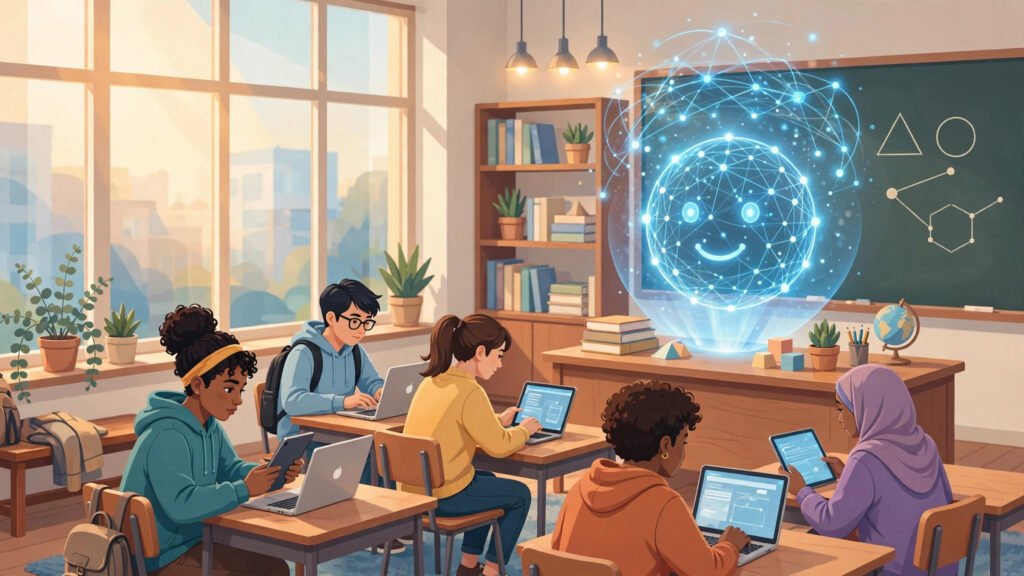
AI in education blends human teaching with intelligent software that adapts to every learner.
🤖 What Is AI in Education?
AI in education refers to the use of artificial intelligence technologies — machine learning, natural language processing, adaptive algorithms, and generative AI — to support teaching, learning, assessment, and school administration. In practice, it covers everything from a chatbot that answers a student’s homework question at 10 p.m. to a district-wide system that predicts which students are at risk of falling behind.
Unlike traditional educational software, which delivers the same content to everyone, AI in education systems learn from each student’s responses. When a learner struggles with fractions, the system offers more practice at the right difficulty. When a student masters a topic quickly, it moves them ahead instead of making them wait. This adaptive quality is what makes AI-powered learning so powerful — and so different from the one-size-fits-all classroom.
The main building blocks of AI in education include:
- Adaptive learning platforms that personalise content, pace, and difficulty for each student.
- Intelligent tutoring systems that give step-by-step guidance, hints, and feedback like a patient human tutor.
- Generative AI assistants that help students brainstorm, draft, summarise, and revise their work.
- Automated assessment tools that grade quizzes, essays, and coding assignments in minutes.
- Learning analytics dashboards that show teachers exactly where each student stands.
- Administrative automation that handles scheduling, enrolment, and reporting.
📊 Why AI in Education Matters in 2026
The case for AI is no longer theoretical. Adoption has accelerated sharply as generative AI tools became widely available, school budgets tightened, and employers demanded new digital skills. UNESCO has repeatedly emphasised that AI must be human-centred, inclusive, and guided by clear policy — a signal that the technology has entered the mainstream of global education planning.
Here is why AI matters more than ever in 2026:
- Personalisation at scale: A single teacher with 30 students cannot give each child a fully personalised lesson. AI can. Adaptive platforms adjust in real time, closing gaps before they widen.
- Teacher workload crisis: Teachers routinely report spending 10–15 hours a week on grading, planning, and paperwork. AI automation returns much of that time to actual teaching.
- Learning recovery: After years of pandemic-era disruption, many students still have uneven foundations. AI-driven diagnostics pinpoint exactly which skills are missing.
- Access and equity: A good AI tutor costs a fraction of private tutoring, giving students in under-resourced schools access to support that was once reserved for wealthy families.
🚀 9 Ways AI in Education Is Transforming Learning
Below are the nine most important ways AI is transforming learning in 2026, with real examples you can apply today.
1. Personalised Learning Paths for Every Student
The flagship promise of AI is true personalisation. Adaptive platforms such as Khan Academy’s Khanmigo, DreamBox, and ALEKS analyse each student’s answers and adjust the next question’s difficulty, topic, and format. A student who aces algebra moves on to geometry; a student who stumbles gets targeted practice, video explanations, and hints until the concept clicks. No one is bored, and no one is left behind.
2. AI Tutors Available 24/7
Human tutors sleep. AI tutors do not. AI gives every student an on-demand tutor that answers questions, explains concepts in multiple ways, and never loses patience.
3. Instant, Actionable Feedback on Writing and Work
Traditionally, students waited days for feedback on an essay — long after the lesson had moved on. With AI tools, students get immediate feedback on grammar, structure, argumentation, and clarity, then revise while the ideas are still fresh. Teachers still give the final judgement, but AI handles the first pass, so feedback arrives when it can actually change the outcome.
4. Automated Grading and Assessment
Grading is one of the biggest time sinks in teaching. AI platforms now grade multiple-choice tests, short answers, maths working, and even code automatically — and assist with rubric-based essay scoring. The time saved is substantial: teachers report cutting grading time by half or more, freeing evenings and weekends for lesson design and student support.
5. Early Warning Systems That Catch Struggling Students
Learning analytics powered by AI can spot at-risk students weeks before a human would notice — flagging patterns like declining quiz scores, falling engagement, or missed assignments.
6. AI in Education for Special Needs and Accessibility
AI is a breakthrough for accessibility. Text-to-speech and speech-to-text tools help students with dyslexia and visual impairments. Real-time captioning supports deaf and hard-of-hearing learners. Translation tools give multilingual students full access to lessons. AI-powered reading assistants adjust text complexity for different reading levels. For the first time, truly inclusive classrooms are achievable at scale.
7. Smarter Lesson Planning and Content Creation
Teachers now use generative AI to draft lesson plans, create differentiated worksheets, generate quiz questions at multiple difficulty levels, and produce summaries for absent students. What once took a Sunday afternoon takes 20 minutes. The best practice is clear: teachers use AI to draft, then apply their professional judgement to refine. AI works best as a co-planner, not an autopilot.
8. Gamified, Engaging Learning Experiences
AI-driven gamification adapts challenges to each student’s skill level, keeping them in the “flow zone” — neither bored nor overwhelmed. Language apps like Duolingo have pioneered this approach, and classroom platforms are following: adaptive quizzes, AI-generated scenarios, and personalised challenges that make practice feel like play. Engagement is what keeps students practising long enough to master hard skills.
9. AI in Education for Career Guidance and Skills Mapping
The newest frontier is career readiness: AI platforms analyse a student’s strengths and coursework, then suggest career paths, skill gaps, and relevant courses.
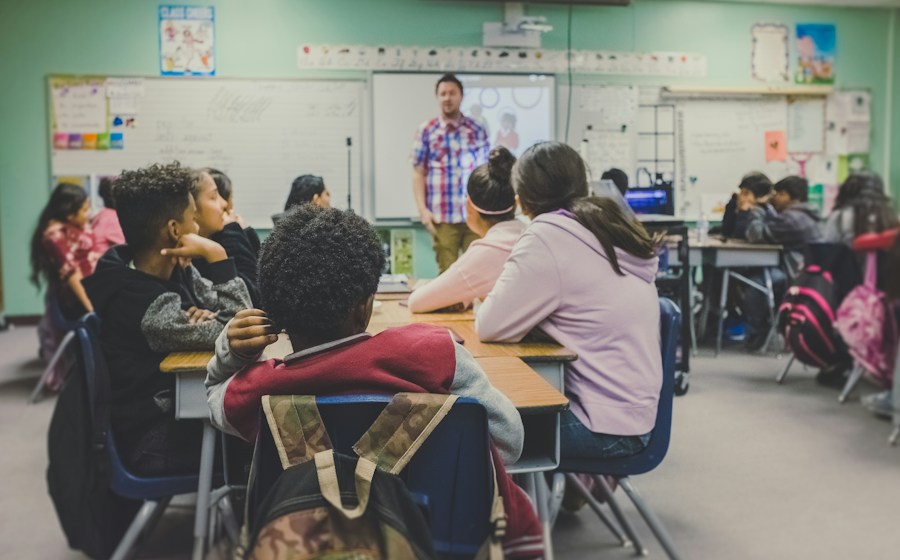
Classrooms using AI give teachers real-time insight into every student’s progress.
🛠️ Best AI in Education Tools for 2026
Choosing the right platform is half the battle. Here are the leading AI tools in 2026, grouped by use case, with honest notes on pricing and best fit.
- Khanmigo (by Khan Academy) — AI tutor and teacher assistant built on Khan Academy’s curriculum. Excellent for maths, science, and humanities. Pricing: around $4 per student per month for schools, with district plans available.
- Duolingo — The gold standard for AI-driven language learning, with adaptive practice and gamified lessons. Free tier available; Super plans from roughly $7–$13 per month.
- Quizlet / Quizlet AI — Flashcards supercharged with AI-generated study sets, practice tests, and explanations. Free tier plus Plus plans from about $8 per month.
- Grammarly for Education — AI writing feedback on grammar, clarity, and academic integrity. Free tier; education plans typically $12–$15 per user per month.
- ChatGPT / Gemini / Claude (education plans) — General-purpose AI assistants that teachers and students use for brainstorming, tutoring, and lesson drafting. Education and team plans typically $20–$30 per user per month.
How to choose: Start with one problem — tutoring, grading, or lesson planning — and pick the tool that solves it best. Avoid buying five platforms at once. A single well-adopted AI tool beats a shelf full of unused licences. If your organisation is already investing in business automation, our guide to AI automation tools shows how the same principles apply beyond the classroom, and our roundup of AI tools for small business covers budget-friendly options for training teams.
💰 How Much Does AI in Education Cost?
Costs for AI vary widely — from free tiers to six-figure district rollouts. Here is a realistic range for 2026:
- Individual teachers: $0–$30 per month using free tiers and a single AI assistant subscription.
- Small schools (up to 500 students): $2,000–$15,000 per year for one or two platforms, depending on per-student pricing.
- Large schools and districts: $25,000–$250,000+ per year for district-wide adaptive learning, analytics, and training.
- Universities: Enterprise contracts often run $50,000–$500,000+ annually, including integrations with learning management systems.
👩🏫 AI in Education: Benefits for Teachers
- Hours returned every week: Automated grading, attendance summaries, and draft lesson plans give teachers back 5–10 hours weekly.
- Better insight, faster: Dashboards show exactly which students need help and on which topics — no more guessing from a single test score.
- Differentiated materials in minutes: AI generates three reading levels of the same worksheet, so every student gets work at their level.
- More time for humans: With admin work reduced, teachers can focus on discussion, mentoring, and pastoral care — the work only humans can do.
⚠️ Challenges and Risks of AI in Education
AI is powerful, but it is not risk-free. Honest planning means confronting the challenges head-on:
- Academic integrity: Students can use generative AI to complete assignments without learning. Schools need clear policies, AI-aware assessments, and detection as one signal among many — never as sole proof.
- Data privacy: AI systems process sensitive student data. Choose vendors with strong privacy commitments, data-minimisation practices, and compliance with regulations such as FERPA, GDPR, and local student-data laws.
- Bias and accuracy: AI models can reflect biases in their training data and can produce confident-sounding errors. Teach students to verify AI output, and never let AI make high-stakes decisions alone.
- Over-reliance: If students outsource all thinking to AI, critical-thinking skills suffer. OECD PISA findings show that heavy reliance on ready-made AI answers is linked to weaker learning outcomes. The best classrooms use AI for practice and feedback — not as a substitute for doing the work.
- Equity gaps: AI only helps students who have devices and connectivity. Schools must plan for access, or AI will widen the very gaps it promises to close.
The answer is governance: a written AI policy, staff training, transparent vendor contracts, and regular audits. Schools that govern AI well get the benefits while keeping risks under control. For a parallel look at how AI is transforming another regulated field, see our guide to AI in healthcare.

The future of AI is collaborative: students, teachers, and intelligent tools working together.
✅ How to Implement AI in Education in Your School
Rolling out AI does not have to be chaotic. Follow this six-step roadmap:
- Define one clear goal. Pick a measurable outcome — for example, “improve Year 8 maths pass rates by 10%” or “cut teacher grading time by 30%.” One goal beats ten vague ambitions.
- Form a small AI team. Include a senior leader, two or three enthusiastic teachers, an IT lead, and a data-privacy contact. Small, empowered teams move faster than large committees.
- Write a short AI policy. Cover acceptable student use, data handling, academic integrity, and which tools are approved. Publish it for staff, students, and parents.
- Pilot with one subject and one tool. Run a 6–8 week pilot in a single department. Measure results, gather teacher feedback, and fix problems before scaling.
- Train teachers properly. Budget at least two training sessions plus ongoing coaching. Training is where most AI in education rollouts succeed or fail.
- Scale what works, drop what does not. Expand the pilot to more subjects only if the data supports it. Be willing to cancel tools teachers do not use.
🔮 The Future of AI in Education
Looking ahead, expect AI tutors that read a student’s emotions, immersive simulations for science and history, real-time translation in multinational classrooms, and lifelong learning companions that follow students from school into their careers.
📌 Key Takeaways
- AI personalises learning at a scale no human teacher can match alone.
- The biggest wins today are AI tutoring, automated grading, and early-warning analytics.
- Costs range from free teacher tools to enterprise district contracts — start small and scale on evidence.
- Teachers benefit as much as students, gaining hours back for mentoring and discussion.
- Governance — policy, privacy, training — is what separates successful rollouts from risky ones.
❓ Frequently Asked Questions
What is AI in education?
AI is the use of artificial intelligence — adaptive learning, intelligent tutoring, generative AI, and learning analytics — to personalise teaching, automate assessment, and support students and teachers.
How is AI used in education today?
Common uses include AI tutors, adaptive practice, automated grading, lesson-planning assistants, early-warning systems, and accessibility tools.
Will AI replace teachers?
No. AI automates repetitive tasks and personalises practice, but mentoring, motivation, classroom management, and pastoral care remain deeply human work. The best results come from teachers and AI working together.
Is AI in education safe for students?
It can be, when schools choose privacy-compliant vendors, minimise data collection, publish a clear AI policy, and teach students to verify AI output. Always review vendor privacy terms before adopting a tool.
Sources note: This article draws on publicly available guidance from UNESCO on AI, OECD research on AI, skills, and PISA findings on AI use and learning, and vendor documentation from the tools listed above. Tool pricing reflects typical 2025–2026 list pricing and may vary by region and plan.