
A small business owner knows the feeling. A lead asks for a quote on Monday, and by Friday nobody has followed up, because the week filled with deliveries, invoices, and a broken printer. The lead went quiet, then bought from the competitor who replied on Tuesday. The sale was not lost on price. It was lost on follow-up. AI sales tools for small business exist to stop that from happening.
That is the job AI sales tools for small business are built for. They remember every lead, write the follow-up before you ask, tell you which deal is most likely to close, and warn you when a deal is going cold. The owner still makes the call and still closes the sale. The tool just stops the sale from slipping away while the owner is busy running the business.
This guide covers seven picks. Each one does a different part of selling, each one can be tried without a big budget, and each one is judged the same way: what it does well, where it needs a human, and which kind of small business it suits best. If you want the wider comparison first, the best AI tools for small business guide covers fifteen categories in one place, and the best free AI tools for small business guide lists ten picks that cost nothing to start with. If you are new to all of this, start with how to use AI for small business before you buy anything.
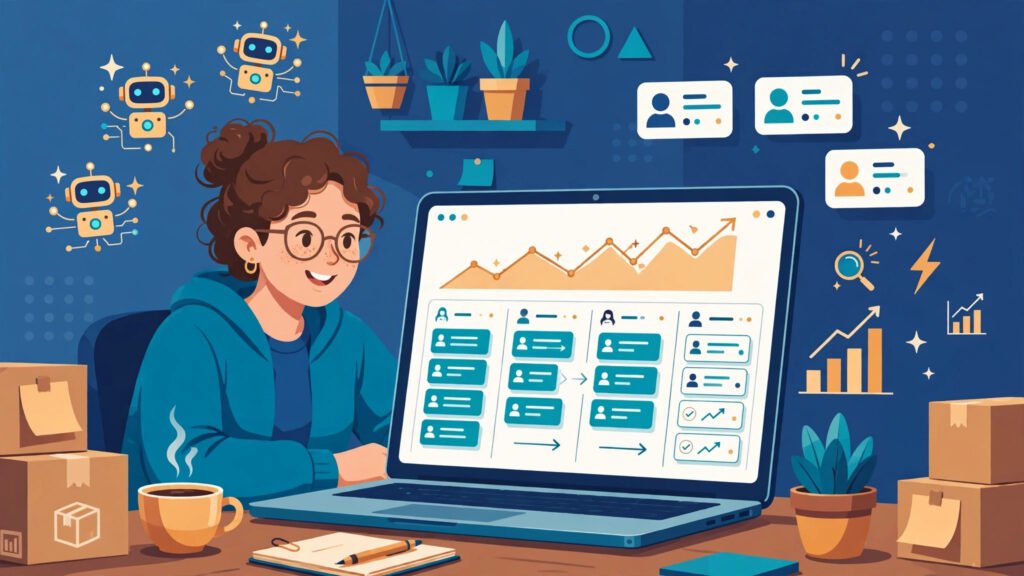
What AI sales tools for small business should do
Before the tools, it helps to name the jobs. Selling for a small business is not one job. It is five small jobs that repeat every week.
First, finding leads. Who might buy, where do they work, and how do you reach them without spending the whole morning searching.
Second, the follow-up. The first email is easy. The third email, sent at the right time, with the right detail, is where most small businesses stop. That is where most sales are lost.
Third, the pipeline. Which deals are moving, which are stuck, and which one deserves the next call. A pipeline nobody looks at is just a list.
Fourth, the conversation. What did the customer actually say on the call, what did they worry about, and what did you promise to send. Memory fades. A record does not.
Fifth, the forecast. How much will actually close this month, so the owner can plan stock, staff, and spending with something better than a guess.
Seven tools cannot do all five jobs perfectly. But each tool below takes one job and makes it lighter, and together they cover the whole week. Pick the job that hurts most, start there, and add the next tool only when the first one is part of your routine. That is the test every one of the AI sales tools for small business in this guide had to pass.
1. HubSpot Sales Hub — the all-in-one that remembers everything
HubSpot Sales Hub is the all-in-one tool on this list. It is a CRM with AI built in: it writes emails, scores leads, books meetings, and keeps every call, email, and note on one contact record, so nothing depends on one person’s memory.
Its strength is that it ends the scattered notes. A lead who emailed in January, called in March, and asked for a quote in June is one record with the whole story, not three inboxes and a notebook. The AI assistant drafts the follow-up in your tone, suggests the next step, and flags the deals that have gone quiet. For a business that loses sales to slow follow-up, that memory is where AI sales tools for small business earn their keep.
Its weakness is that an all-in-one tool asks for setup. The free CRM is a genuine place to start, but the fuller AI features sit on paid plans, and a business that only needs follow-up emails may find it heavier than it needs. The fix is to start free, use the pipeline and email tools for a month, and only pay for the AI features once the free routine is actually happening every day.
Best for: owners who want one place for leads, emails, and deals, and small teams that need everyone to see the same pipeline. The CRM side of this is covered in the AI CRM tools for small business guide.
2. Pipedrive — the pipeline you can actually read
Pipedrive is the pipeline tool on this list. It shows every deal as a card moving across stages, from first contact to signed, and its AI sales assistant watches the board and tells you which deals need attention today.
Its strength is clarity. An owner can look at the board for one minute in the morning and know exactly which three deals to chase. The AI assistant suggests the next action on a stuck deal, summarizes long email threads, and estimates which deals are likely to close. A pipeline you can read in a minute is a pipeline you actually use, and that is the quiet strength of AI sales tools for small business.
Its weakness is that it is a sales tool, not a marketing tool. It will not find you new leads or write your blog posts. The fix is to use it for what it is: the board where deals move, and the nudge that stops a deal from sitting untouched for two weeks. Pair it with a prospecting tool for the top of the funnel, and the routine is complete.
Best for: owners who sell by phone and email and want a simple board instead of a spreadsheet, and small teams that need to see, at a glance, what will close this month.
3. Zoho CRM — an AI assistant that watches the whole business
Zoho CRM is the AI-assistant tool on this list. Its built-in assistant, Zia, reads the sales data and speaks up: this deal looks like it will close, that lead has gone cold, this customer usually buys again in spring.
Its strength is that it turns data into advice. A small business collects a lot of sales data and rarely reads it. Zia reads it, predicts which deals need a call, spots unusual patterns, and answers plain questions about the pipeline in plain words. For an owner who wants a second pair of eyes on the numbers without hiring an analyst, that is where AI sales tools for small business prove their value.
Its weakness is that the advice is only as good as the data. If the team does not log calls and update deal stages, Zia has little to work with. The fix is a small habit: update the deal right after the call, every time, even in one line. The AI does the thinking. The human still has to feed it the facts.
Best for: businesses already using Zoho for email or accounts, and owners who like the idea of an assistant that reads the pipeline and tells them what to do next.
4. Salesforce Sales Cloud — Einstein for teams that outgrew spreadsheets
Salesforce Sales Cloud is the enterprise-grade tool on this list, with Einstein AI built into the CRM. It scores every lead, predicts which opportunities will close, and suggests the next best action for each deal, across a whole team.
Its strength is scale. When five people sell at once, nobody can hold the whole pipeline in their head. Einstein watches every deal, every email, and every call, and tells each person what to do next and which deal deserves attention. The forecasting is the strongest on this list, built for managers who need a number they can plan around. For a growing business that sells in volume, that is where AI sales tools for small business stop being a helper and start being the system.
Its weakness is that it is the heaviest tool here. Setup takes time, the learning curve is real, and it is priced for teams, not for a one-person shop. The fix is to only reach for it when the team has genuinely outgrown a simpler CRM. A business with two salespeople and a short pipeline will move faster on a lighter tool.
Best for: growing teams with several salespeople, a manager who needs a real forecast, and businesses that already live in the Salesforce world.
5. Apollo.io — find the lead, then write to them
Apollo.io is the prospecting tool on this list. It is a large database of businesses and contacts, with AI that helps you find the right people, write the first email, and run a sequence of follow-ups automatically until they reply.
Its strength is that it fills the top of the funnel. A business that knows who its customers are but does not know how to reach them can build a list in an afternoon: the right job titles, the right company size, the right city. The AI writes the first email in a human tone, and the sequence keeps following up politely so the owner does not have to remember to. Prospecting is the job most small businesses skip, and that is why AI sales tools for small business so often start here.
Its weakness is that a list is not a relationship. Cold emails sent in bulk get ignored, and a sequence that never stops can damage a reputation. The fix is to keep the list small and specific, write the first line yourself, and stop the sequence the moment someone replies. The tool finds the people. The human still earns the reply.
Best for: businesses that need new leads every week and know exactly who their customer is, and owners who want prospecting and follow-up in one place.
6. Gong — learn from every sales call
Gong is the conversation tool on this list. It records sales calls and meetings, transcribes them, and uses AI to show what actually happened: what the customer worried about, what the salesperson promised, which questions came up again and again, and where deals went quiet.
Its strength is that it turns calls into coaching. An owner who cannot sit in on every call can read the summary of each one in two minutes, and a salesperson can see exactly where a deal stalled instead of guessing. Over time, the patterns show up: the objection that kills most deals, the question that always comes too late, the pitch that works. For a team that sells by talking, that is where AI sales tools for small business pay for themselves.
Its weakness is that it is built for teams that talk a lot. A one-person business making a handful of calls a week will learn less from it than a team making dozens. The fix is to use it when calls are the main way you sell, and to review one call a week together, so the lesson actually changes the next call.
Best for: teams that sell on calls and video meetings, managers who coach a sales team, and businesses that want to know why deals are really lost.
7. Clari — a forecast you can plan the month around
Clari is the forecasting tool on this list. It pulls the pipeline, the emails, the calls, and the CRM history together, and uses AI to predict which deals will actually close and how much revenue the month will end with.
Its strength is honesty about the pipeline. Every owner has looked at a pipeline full of deals and wondered how many are real. Clari scores each deal against how similar deals behaved before, flags the ones that are slipping, and gives a number the owner can plan stock and spending around. A forecast that has been right three months in a row changes how a business is run, and that is the promise of AI sales tools for small business at their best.
Its weakness is that it needs history to learn from. A new business with a short pipeline and few closed deals gives it little to work with. The fix is to use it once the pipeline has a few months of real deals behind it, and to keep the CRM updated, because the forecast is only as honest as the data feeding it.
Best for: businesses with a steady flow of deals and a manager who needs a reliable monthly number, and teams that have outgrown guessing from a spreadsheet.
Comparison table
| Tool | Best job | Standout AI feature | Best for |
|---|---|---|---|
| HubSpot Sales Hub | All-in-one CRM and follow-up | AI email writing, lead scoring, deal alerts | Small teams wanting one place for everything |
| Pipedrive | Readable pipeline | AI sales assistant, deal insights | Owners who sell by phone and email |
| Zoho CRM | AI assistant on the data | Zia predictions and anomaly alerts | Businesses already using Zoho |
| Salesforce Sales Cloud | Team selling at scale | Einstein lead scoring and forecasting | Growing teams with a sales manager |
| Apollo.io | Finding new leads | AI prospecting lists and email sequences | Businesses needing new leads weekly |
| Gong | Learning from calls | Call transcription and deal insights | Teams that sell on calls |
| Clari | Honest forecasting | AI revenue prediction and deal risk | Businesses planning around a monthly number |
How to choose your first AI sales tool
Start with the job that loses you the most sales. If leads go cold because nobody follows up, start with HubSpot or Pipedrive. If you have no new leads at all, start with Apollo.io. If you cannot see the pipeline clearly, start with Pipedrive or Clari. If your team sells on calls and you never know why deals die, start with Gong. The right first tool is the one that fixes the leak you already have, not the one with the longest feature list.
Then try it on real deals, not on a demo. Give it one week, five real leads, and one real follow-up sequence. If the team uses it every day without being reminded, it fits. If it sits unused after three days, it does not, and no feature list will save it. If you are still torn between two tools, the which AI tool is best for small business guide walks through choosing by job, not by brand. The AI automation tools for small business guide shows how to connect the winner to the rest of the routine, and the AI email marketing tools for small business guide covers the follow-up emails themselves.
Mistakes to avoid with AI sales tools
The first mistake is buying the biggest tool first. A one-person business does not need enterprise forecasting, and a team of two does not need a tool built for two hundred. Start small, prove the routine, then grow.
The second mistake is letting the AI write everything and sending it without reading. Customers can tell when a follow-up was written by nobody in particular. Read every AI draft once, add one real detail from the last conversation, and then send it. One real detail is worth ten polished sentences.
The third mistake is a dirty pipeline. Deals that closed months ago still sitting open, leads nobody called still marked hot. The AI reads the pipeline you give it. Clean it once a week, close what is dead, and the advice gets better every week. The AI research tools for small business guide helps with the homework before the first call, and the AI content writing tools for small business guide helps with the words when you need them.
Frequently asked questions
Do AI sales tools replace salespeople?
No. They replace the remembering, the typing, and the chasing. The call, the relationship, and the close still belong to a human. A business that tries to automate the whole sale usually ends up with polite emails and no orders.
What is the best AI sales tool for a very small business?
Start with the free CRM in HubSpot or a simple pipeline in Pipedrive. Both can be tried without a big commitment, and both cover the two jobs that matter first: remembering every lead and following up on time. Move to a heavier tool only when the team outgrows the simple one.
Can AI sales tools help with cold outreach?
Yes, Apollo.io is built for it, and HubSpot and Pipedrive can run follow-up sequences too. But keep the list small, write the first line yourself, and stop the moment someone replies. A short, honest email to the right person beats a hundred generic ones.
How much should a small business spend on AI sales tools?
Start with what can be tried free, and pay only for the tool the team actually uses every day. If a tool saves two hours a week and stops one deal a month from going cold, it has earned its place. If nobody opens it, cancel it, whatever it costs.
Do these tools work for service businesses, not just product sellers?
Yes. Coaches, agencies, clinics, and trades all sell the same way: a lead, a conversation, a quote, a follow-up, a close. The tools in this guide fit any business that tracks deals and follows up, and the AI tools for small business marketing guide covers the marketing side of the same funnel.
Conclusion
The sale is rarely lost in the meeting. It is lost in the week after, when nobody follows up, the deal goes cold, and the customer buys from the business that replied. AI sales tools for small business exist to stop that week from happening: they remember the lead, draft the follow-up, watch the pipeline, and tell you which deal needs a call today.
Pick one tool, use it on five real deals this week, and judge it by one question: did fewer deals go cold? If the answer is yes, keep it, and add the next tool only when the first one is part of the routine. If you want to see how other small businesses are putting AI to work, AI Tool Steps has step-by-step guides for the tools in this list and many more.