
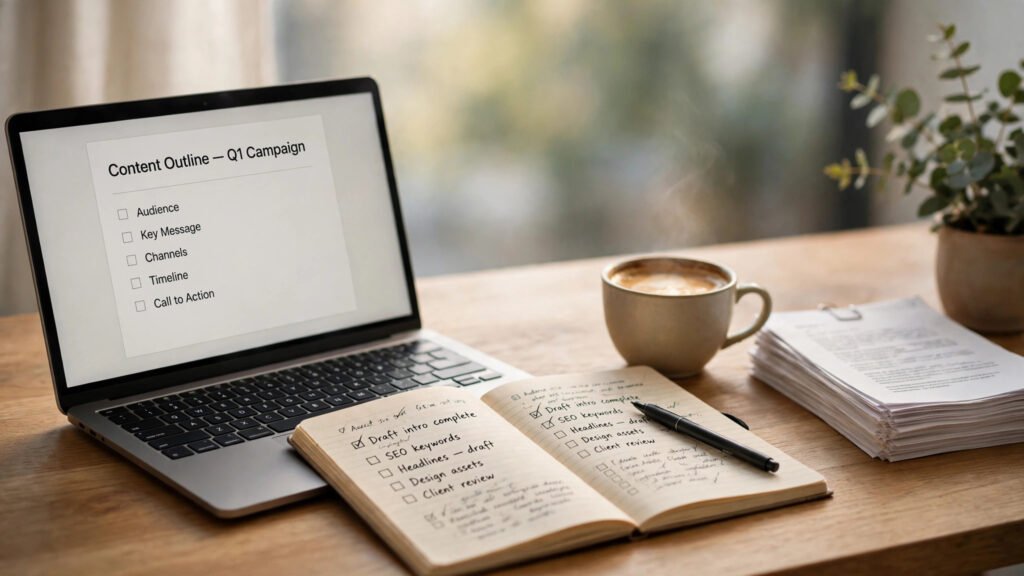
Why Your Small Business Needs a Content Briefing System That Works in 2026
Imagine this: you sit down to write a blog post for your small business on a Monday morning, and by Monday afternoon the draft is done, optimized, and already ranking on page one. Sound like a fantasy? For most small businesses, it is — but not because they lack talent or ideas. It is because they lack a briefing system.
An AI content brief generator for small business turns your rough topic ideas into structured, SEO-ready briefs in minutes — the kind of briefs that used to take an agency strategist three hours and a spreadsheet to build. And in a search landscape where 94% of web pages receive zero organic traffic from Google (Backlinko, 2025), a great brief is the difference between content that ranks and content that nobody ever sees.
In this guide, you will learn exactly what an AI content brief generator does, compare the 7 best tools for small businesses in 2026, see a worked example for a fictional bakery you can copy today, and take home a 5-part brief template that makes every article you publish stronger.
🔑 Key Takeaways
- An AI content brief generator converts a keyword or topic into a structured brief — title options, headings, questions to answer, word count, internal links — in minutes, not hours.
- Small businesses that brief before writing rank faster: top-10 pages average 1,447 words of structured coverage (Backlinko), and briefs guarantee that coverage.
- The 7 best tools for 2026 include free and budget-friendly picks — no agency retainer required.
- The 5-part anatomy (goal, keyword cluster, outline, questions, links) works with any AI brief generator.
- Our worked bakery example shows the full workflow from keyword to publish-ready brief in under 30 minutes.
📋 Table of Contents
- What Is an AI Content Brief Generator?
- Why Small Businesses Need AI-Powered Content Briefs in 2026
- How AI Content Brief Generators Actually Work
- 7 Best AI Content Brief Generators for Small Business in 2026
- The 5-Part Anatomy of a Rank-Ready Content Brief
- Step-by-Step: Build Your First AI Content Brief in 30 Minutes
- Worked Example: “Maple & Co.” Bakery Brief
- 6 Mistakes That Ruin AI-Generated Briefs
- Frequently Asked Questions

A structured content brief is the blueprint behind every article that ranks — and AI now builds it in minutes.
🤖 What Is an AI Content Brief Generator?
An AI content brief generator is a tool that takes a topic, keyword, or rough idea and produces a structured content brief — a blueprint telling your writer (or you) exactly what to cover. A good brief includes:
- SEO title and meta description options built around your focus keyword.
- A heading outline (H2/H3) that mirrors what is actually ranking for the query.
- Questions to answer — the “People Also Ask” and related searches your article must address.
- Word count and reading level targets based on the top-ranking pages.
- Internal and external link suggestions to wire your article into your site’s architecture.
Think of it as the difference between telling a contractor “build me a house” and handing them an architect’s plan. Both might get you a house — but only one gets you the house you actually wanted. Small businesses, which usually have no in-house SEO strategist, benefit most: the AI does the competitive research that used to take hours.
Why Small Businesses Need AI-Powered Content Briefs in 2026
The numbers tell the story. Google handles over 5 trillion searches a year (Google, 2025), yet 94% of web pages receive zero organic traffic (Backlinko/Ahrefs). Most small-business blogs fail silently — not because the writing is bad, but because the article was never briefed to compete.
Consider three realities of 2026:
- Search is zero-click: 68% of US Google searches ended without a click in early 2026 (SparkToro/Similarweb). Your content must be structured to win featured snippets and AI Overview citations — and that structure comes from the brief, not the draft.
- Depth wins: pages ranking in Google’s top 10 average 1,447 words of comprehensive coverage (Backlinko). A brief enforces that coverage before a single paragraph is written.
- AI search rewards expertise: 91% of marketers say SEO positively impacts their goals (Conductor, 2025), but in the AI-search era, thin content is invisible. Briefs force you to plan original angles, statistics, and examples — exactly what generative engines cite.
The business case is simple math. A freelancer charging $150 for a blog post will deliver dramatically better work from a sharp brief than from a one-line Slack message — and AI generates that sharp brief in about ten minutes. For small businesses watching every dollar, the AI content brief generator for small business is one of the highest-ROI tools you can adopt this year.
How AI Content Brief Generators Actually Work
Under the hood, the workflow is the same across nearly every tool. Understanding it helps you judge brief quality:
- SERP analysis. You enter a focus keyword. The tool pulls the top 10–20 ranking pages and analyzes their headings, word counts, and topics.
- Gap detection. It compares those pages against your existing site, flagging subtopics competitors cover that you do not.
- Question extraction. It collects “People Also Ask” questions, forum threads, and related searches the brief must answer.
- Outline assembly. It arranges headings, questions, and keyword targets into a writer-ready document.
- Link mapping. Better tools suggest internal pages to link to, strengthening your site’s topical authority.
That is the mechanics. The strategy — which keyword to brief, what angle to take, which original examples to include — still needs a human brain. The AI does the homework; you make the decisions.

AI brief generators analyze the top-ranking pages and hand you the blueprint to compete with them.
📊 7 Best AI Content Brief Generators for Small Business in 2026
We evaluated the market for features that matter to small teams: accuracy of SERP analysis, price, ease of use, and integration with a broader AI content workflow for small business. Here is the honest shortlist:
| Tool | Best For | Starting Price | Standout Feature |
|---|---|---|---|
| Surfer SEO | Data-driven briefs | ~$79/mo | Content score that predicts ranking potential |
| Frase | Question-based briefs | ~$45/mo | Automatic PAA + forum question harvesting |
| MarketMuse | Topical authority | Free tier | Content inventory scoring across your whole site |
| Clearscope | Writer-friendly briefs | ~$170/mo | Letter-grade content reports writers actually read |
| Scalenut | Budget all-in-one | ~$20/mo | Brief + draft generation in one dashboard |
| ChatGPT / Claude | Free custom briefs | Free | Unlimited custom brief templates with the right prompt |
| AlsoAsked + Sheets | DIY question maps | ~$19/mo | Visual question clusters for FAQ sections |
For most small businesses, the sweet spot is a hybrid setup: a free or low-cost tool like ChatGPT or MarketMuse’s free tier for brief generation, plus a step-by-step writing assistant from the many step-by-step AI tutorials available on AIToolSteps to keep your prompting sharp. You do not need the $170/month tier to out-brief competitors who are not briefing at all.
The 5-Part Anatomy of a Rank-Ready Content Brief
Whatever tool you use, insist your brief contains these five parts. If a generator skips one, add it manually:
- Goal and search intent. One sentence: what should the reader be able to do after reading? (Informational, commercial, or transactional?)
- Keyword cluster. Your focus keyword plus 3–5 supporting terms and synonyms the article must weave in naturally.
- Heading outline. 8–12 H2/H3 headings, sequenced the way a reader thinks — with the focus keyword or a synonym in at least three of them.
- Questions to answer. 4–6 real questions from “People Also Ask” and forums. These become your FAQ section and your best shot at featured snippets.
- Link plan. 2–3 internal links to your own related content and 2–3 external links to authoritative sources.
This anatomy is the backbone of the broader AI editorial calendar for small business — when every brief follows the same 5-part format, planning a quarter of content becomes a repeatable system instead of a creative scramble.
✍️ Step-by-Step: Build Your First AI Content Brief in 30 Minutes
Here is the exact workflow, using free tools so you can try it today:
- Pick one long-tail keyword (5 min). Choose something specific like “best sourdough bread near downtown lahore” rather than “bread”. Long-tail keywords have lower competition and clearer intent.
- Run it through your brief generator (10 min). Enter the keyword into Frase, MarketMuse, or a well-prompted ChatGPT. Capture the outline, questions, and word-count target.
- Write the intent sentence (2 min). Example: “After reading, a busy parent should be able to order a custom birthday cake online in under 5 minutes.”
- Add your original angle (8 min). This is the step most businesses skip. Add one statistic from your own sales data, one customer story, or one original photo. AI Overview-era search rewards originality.
- Map the links (5 min). Pick 2–3 related pages on your site — this is how you build the internal-link network search engines love. For a complete picture of how briefing fits a full publishing system, see our guide to AI tools for small business.
Total time: 30 minutes. Result: a brief that would have cost $200 from a freelance strategist.
🧁 Worked Example: “Maple & Co.” Bakery Brief
Meet Maple & Co., a fictional 4-person bakery in Lahore that wants to rank for custom cake orders. Here is the brief their owner generated with a free AI tool, edited in 15 minutes:
- Focus keyword: “custom birthday cake order lahore”
- Intent: Transactional — the reader wants to order a cake, not read about cakes.
- SEO title: Custom Birthday Cake Order Lahore: 2026 Price Guide
- Outline highlights: pricing tiers by serving size (with a real price table), 48-hour ordering timeline, flavor gallery, delivery zones, customer reviews section, FAQ answering “how far in advance should I order?”
- Original angle: a photo series of their 5 most-ordered designs with the actual hours each took — content no competitor can copy.
- Internal links: to their menu page, catering page, and a previous blog post about wedding cakes.
Notice what the AI did not do: it did not invent the prices, the photos, or the customer stories. Those came from the bakery. The AI content brief generator supplied the structure; the business supplied the substance. That division of labor is the entire secret.

Briefing is a team sport: the AI supplies structure, the business supplies the stories only it can tell.
⚠️ 6 Mistakes That Ruin AI-Generated Briefs
- Briefing a head keyword. “Content marketing” is unwinnable for a 10-person business; “AI content brief generator for small business” is a fight you can win. Specificity is strategy.
- Accepting the outline verbatim. AI outlines reflect the average of what ranks — your article must exceed that average. Always add or reorder at least two sections.
- Skipping the original angle. A brief with no original data, example, or case is a recipe for content that AI search engines will summarize — not cite.
- Ignoring search intent. If the keyword is transactional and your outline is informational, you briefed the wrong article.
- Forgetting internal links. A standalone article is an island. Link it into your AI tools for small business pillar and related posts so authority flows through your site.
- Briefing once and never updating. SERPs change. Re-run your briefs quarterly for your money pages — a 10-minute refresh keeps rankings alive.
❓ Frequently Asked Questions
What is an AI content brief generator?
It is a tool that analyzes the top-ranking pages for your keyword and produces a structured writing brief — headings, questions to answer, word-count targets, and link suggestions — so your article is built to compete before you write a word.
Are AI content brief generators free?
Yes, several are. ChatGPT and Claude can generate solid briefs with a good prompt for free, MarketMuse offers a free tier, and paid tools start around $19–$45/month. Most small businesses can start free and upgrade only when volume demands it.
Do AI-generated briefs actually improve rankings?
They improve the inputs that drive rankings — complete coverage, proper structure, and question targeting for snippets. Combined with original examples, briefed articles consistently outperform unbriefed ones.
Can a small business use AI briefs without an SEO expert?
Absolutely — that is the point. The generator performs the competitive analysis an expert would do. You still need to add your business’s original knowledge, but you no longer need to guess what to cover.
Conclusion: Brief First, Write Second
In 2026, the small businesses winning at content are not writing more — they are briefing better. An AI content brief generator for small business compresses hours of competitive research into minutes, enforces the structure that search engines reward, and leaves you free to do the one thing AI cannot: tell your own story.
Start this week: pick one long-tail keyword, generate one brief with a free tool, add one original example, and publish. Briefed content arrives with a plan — and plans rank.
Sources: Google (2025 search volume); SparkToro/Similarweb (zero-click data, 2026); Backlinko SERP analysis (word count, zero-traffic pages); Conductor State of SEO (2025 marketer survey); Ahrefs (AI Overview CTR study, 2026).