
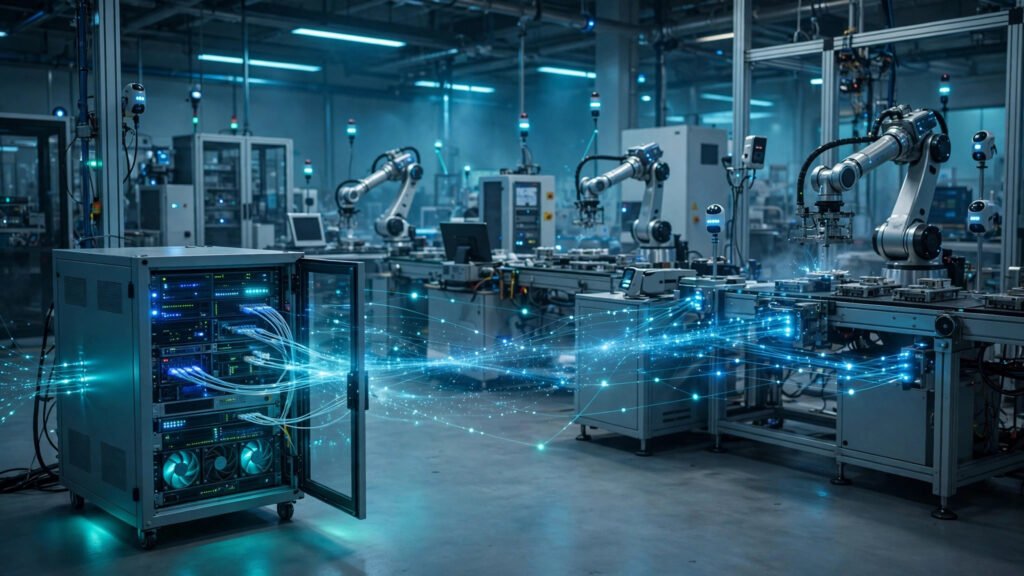
Edge computing technology is changing where data gets processed — and in 2026, it is becoming a competitive advantage for businesses of every size. Instead of sending every sensor reading, video frame, and customer interaction to a distant cloud data center, edge computing technology processes data close to where it is created: on factory machines, in retail stores, inside vehicles, and on smart devices. The result is faster responses, lower bandwidth costs, stronger privacy, and systems that keep working even when connectivity drops.
In this guide, you will learn exactly what edge computing technology is, how it works, the 9 business benefits that matter most, how it compares to cloud computing, the top use cases for 2026, security best practices, costs, and a practical adoption roadmap. This is your complete, jargon-free playbook.
Table of Contents
- What Is Edge Computing?
- How Edge Computing Works
- 9 Business Benefits of Edge Computing
- Edge Computing vs Cloud Computing
- Top Use Cases of Edge Computing in 2026
- Edge Computing and Cybersecurity
- Edge Computing Pricing and Costs
- How to Adopt Edge Computing in 2026
- Future Trends: Edge Computing in 2026 and Beyond
- Key Takeaways
- Frequently Asked Questions
What Is Edge Computing Technology? 🖥️
Edge computing technology is a distributed computing model that moves data processing closer to the source of the data — the “edge” of the network — instead of relying only on a central cloud or on-premises data center. The “edge” can be a sensor on a production line, a camera in a store, a point-of-sale terminal, a connected vehicle, a wearable device, or a small local server in a branch office.
Edge computing technology does not replace the cloud. It complements it. Time-sensitive work happens at the edge, while the cloud handles long-term storage, heavy model training, analytics across locations, and centralized management. Together, they form a hybrid architecture that is faster, more resilient, and more cost-efficient than either approach alone.

Edge computing technology processes data on local devices and gateways, close to where it is generated. Image: Unsplash.
How Edge Computing Technology Works
At its core, edge computing technology follows a simple flow: collect, process, act, and sync. Here is how each step works in practice:
- 1. Data collection: Sensors, cameras, machines, and apps generate data at the edge — temperature readings, video streams, transaction records, or vehicle telemetry.
- 2. Local processing: Edge devices, gateways, or micro data centers filter, analyze, and act on that data immediately using lightweight software and AI models.
- 3. Instant action: The system triggers a response in milliseconds — stopping a machine, alerting staff, adjusting a traffic signal, or personalizing an in-store offer.
- 4. Selective sync: Only the valuable, aggregated results are sent to the cloud for long-term storage, dashboards, and retraining models — not every raw data point.
A modern edge stack typically includes edge devices (sensors, cameras, IoT hardware), edge gateways (local servers that aggregate and secure traffic), edge software platforms (for deploying and managing applications remotely), and cloud orchestration (for updates and analytics).
For a deeper look at cloud foundations, see our guide to Cloud Storage Services 2026: 9 Best Compared, which explains how cloud and edge storage work together.
⚡ 9 Business Benefits of Edge Computing Technology
Why are companies investing in edge computing now? The business case is measurable: faster decisions, lower costs, better experiences, and stronger resilience.
1. Ultra-low latency. Edge computing technology cuts the round trip to a distant data center. Applications that need millisecond responses — robotics, autonomous vehicles, live video analytics, and augmented reality — simply cannot wait for the cloud. Processing locally delivers answers in real time.
2. Lower bandwidth and cloud costs. Streaming every raw video feed or sensor reading to the cloud is expensive. Edge computing technology filters data locally and sends only what matters, slashing bandwidth bills and cloud egress charges.
3. Works offline and stays resilient. When internet connectivity drops, cloud-only systems stall. Edge computing technology keeps critical operations running locally — a factory line, a retail checkout, or a remote clinic — and syncs when the connection returns.
4. Stronger data privacy. Sensitive data — faces, health readings, customer behavior — can be processed on-device without ever leaving the premises. Edge computing technology reduces exposure and helps businesses meet GDPR, HIPAA, and local data-residency rules.
5. Real-time customer experiences. From personalized in-store recommendations to instant fraud checks at checkout, edge computing technology makes interactions feel instant. Speed is not a luxury anymore; it is the experience customers expect.
6. Scalability without central bottlenecks. Adding a new store, clinic, or factory does not mean overloading a central server. Each location gets its own edge capacity, so growth is modular and predictable.
7. Better AI performance. Running lightweight AI models at the edge — defect detection, voice assistants, predictive maintenance — delivers instant insights without cloud delays. The cloud still trains the models; the edge runs them where they matter.
8. Improved security posture. A distributed architecture means no single point of failure. Combined with encryption and zero-trust controls, edge computing technology limits the blast radius of any one breach. Pair it with the tools in our Cybersecurity Tools 2026: 9 Best Picks Compared guide for a layered defense.
9. New revenue opportunities. Edge computing technology enables services that were impossible before: smart-city traffic management, remote equipment monitoring as a service, immersive retail experiences, and real-time logistics tracking. Early adopters are turning edge capabilities into new product lines.
Edge Computing Technology vs Cloud Computing
Edge computing technology and cloud computing solve different problems, and the smartest architectures use both. The table below summarizes the key differences.
| Factor | Edge Computing Technology | Cloud Computing |
|---|---|---|
| Latency | Milliseconds — processed locally | Higher — round trip to a data center |
| Bandwidth use | Low — only key results are sent | High — raw data is uploaded continuously |
| Offline operation | Yes — critical work continues | No — depends on connectivity |
| Best for | Real-time decisions, IoT, AI inference | Big-data analytics, training, storage |
| Scale | Distributed, per-location | Centralized, near-infinite |

Edge computing technology and cloud computing work best together — edge for speed, cloud for depth. Image: Unsplash.
Top Use Cases of Edge Computing Technology in 2026
Here are the use cases delivering real results in 2026:
- Smart manufacturing: Cameras and sensors detect defects, predict machine failures, and adjust production in real time — cutting downtime and scrap rates.
- Retail and smart stores: Edge cameras power shelf monitoring, queue management, and personalized promotions, while edge point-of-sale systems keep checkouts running during outages.
- Healthcare: Patient monitors, imaging devices, and remote clinics analyze vital signs locally for instant alerts, while keeping sensitive health data on-site.
- Autonomous vehicles and logistics: Vehicles process lidar, camera, and sensor data on board in milliseconds. Fleet operators track shipments and optimize routes with live edge telemetry.
- Smart cities: Traffic lights, parking systems, and public-safety cameras use edge computing technology to respond instantly to congestion, accidents, and emergencies.
- Energy and utilities: Smart grids balance loads, detect faults, and integrate renewables using edge analytics at substations and wind farms.
- Media and gaming: Cloud gaming, live sports analytics, and AR/VR experiences rely on edge servers to keep latency invisible to users.
Edge spending keeps climbing. Gartner projected that around 75% of enterprise-generated data would be created and processed outside traditional centralized data centers, while IDC expected worldwide edge computing spending to surpass $230 billion in 2024. Edge computing is now mainstream infrastructure.
🔒 Edge Computing Technology and Cybersecurity
Edge computing changes the security equation: more devices mean more endpoints to protect, but also less sensitive data traveling across networks. Secure every layer — device, network, and cloud — from day one.
- Encrypt everything: Use TLS for data in transit and encryption at rest on every edge device and gateway.
- Adopt zero-trust access: No device or user is trusted by default. Verify identity, enforce least-privilege access, and segment edge networks.
- Keep firmware patched: Automate over-the-air updates so edge devices never run known-vulnerable software.
- Monitor continuously: Central dashboards should track device health, anomalies, and intrusion attempts across all edge locations.
- Protect physical access: Edge hardware in stores, factories, and public spaces needs tamper-resistant enclosures and secure boot.
For authoritative guidance, see the National Institute of Standards and Technology (NIST) cybersecurity framework and Microsoft Azure edge computing documentation on securing distributed architectures.
Edge Computing Technology Pricing and Costs
Edge costs vary widely by scale, but the components are predictable. Budget for these four categories:
- Hardware: Edge devices, gateways, and micro servers range from under $100 for simple sensors to several thousand dollars for AI-capable edge servers per location.
- Software and platforms: Edge management platforms typically charge per device or per location, often $10–$100 per device per month depending on features.
- Connectivity: 5G, broadband, and private networks add recurring costs — though edge filtering usually reduces total bandwidth spending versus cloud-only designs.
- Operations: Remote monitoring, updates, and occasional on-site maintenance. Managed edge services can reduce this burden for small teams.
Cost-saving tip: Start with one high-impact pilot — for example, defect detection on one production line or queue management in one store. Measure latency improvements, bandwidth savings, and downtime reduction before scaling. Most businesses recover pilot costs within 6–12 months through lower cloud bills and fewer disruptions. Compare platform pricing on AWS edge computing and IBM edge computing documentation to benchmark your options.
How to Adopt Edge Computing Technology in 2026
Adopting edge computing does not require ripping out your existing systems. Follow this proven five-step roadmap:
Step 1: Identify latency-sensitive workloads. Audit where delays cost money — production downtime, checkout abandonment, safety incidents, or slow customer service. Those are your edge candidates.
Step 2: Run a focused pilot. Choose one location and one use case. Define success metrics up front: latency, uptime, cost per transaction, or customer satisfaction.
Step 3: Choose the right stack. Match hardware to the workload (simple sensors vs. GPU-powered AI inference), pick a management platform with remote updates, and confirm it integrates with your cloud provider.
Step 4: Lock down security. Apply encryption, zero-trust access, automated patching, and monitoring before you scale. Security retrofits are far more expensive than security by design.
Step 5: Scale in waves. Roll out location by location, reusing the pilot playbook. Track ROI at each wave and feed lessons back into the next deployment.

Security by design is essential for edge computing deployments. Image: Unsplash.
Future Trends: Edge Computing Technology in 2026 and Beyond
Edge computing is evolving fast. Watch these five trends shaping the next wave:
- AI at the edge goes mainstream: Smaller, faster AI models will run on cameras, drones, and wearables — enabling instant decisions without cloud round trips.
- 5G and private networks expand: Faster, more reliable wireless connectivity makes edge deployments viable in factories, ports, hospitals, and rural sites.
- Edge + IoT + digital twins: Real-time edge data feeds digital twins of factories, buildings, and cities, enabling simulation and predictive control.
- Sustainability gains: Processing locally reduces data-center load and energy use, while edge sensors optimize heating, lighting, and logistics.
- Edge-as-a-service grows: Managed platforms and hyperscaler edge offerings lower the barrier for small businesses that want edge benefits without building infrastructure.
Key Takeaways
- Edge computing processes data near its source for speed, resilience, privacy, and lower costs.
- It complements the cloud — edge for real-time decisions, cloud for storage, training, and analytics.
- The top benefits are low latency, lower bandwidth costs, offline resilience, privacy, and real-time experiences.
- Manufacturing, retail, healthcare, logistics, smart cities, and media are already seeing strong ROI.
- Start with one pilot, secure it by design, measure ROI, then scale location by location.
Frequently Asked Questions
What is edge computing in simple terms?
Edge computing processes data close to where it is created — on devices, sensors, or local servers — instead of sending everything to a distant cloud data center. This makes responses faster and systems more resilient.
Is edge computing the same as cloud computing?
No. Cloud computing centralizes processing in large data centers, while edge computing distributes processing to the network edge. Most modern systems use both: edge for speed, cloud for depth.
What are examples of edge computing?
Examples include smart factory sensors, retail shelf cameras, autonomous vehicle computers, patient monitors, smart traffic lights, and content delivery network servers that cache content near users.
Is edge computing secure?
Yes, when designed properly. Encryption, zero-trust access, automated patching, and continuous monitoring protect edge devices. Processing sensitive data locally can also reduce exposure compared to sending it all to the cloud.
How much does edge computing cost?
Costs range from under $100 per simple device to thousands per AI-capable edge server, plus platform and connectivity fees. Most businesses start with a small pilot and recover costs within 6–12 months through lower cloud bills and less downtime.
Conclusion
Edge computing is no longer optional infrastructure for forward-thinking businesses — it is the foundation for real-time AI, resilient operations, and standout customer experiences. Start small, pick one high-impact use case, secure it properly, and scale what works.
Sources: Gartner edge computing research; IDC worldwide edge computing spending forecast; NIST cybersecurity framework; Microsoft Azure, AWS, and IBM edge computing documentation. This article was written by the Digital 365 Agency editorial team and reviewed for accuracy in October 2026.